venerdì 28 dicembre 2007

I Presepi per il Natale 2007 /Cribs for Christmas 2007

Allestimento natalizio con albero e presepio realizzato dai ragazzi della classe 5^B / Christmas preparation with Christmas tree and Crib made by the class 5 B children
Presepio generale realizzato dai ragazzi della classe 5^B/ Total crib made by the class 5 B childrenParticolari: i mestieri/ Details:the jobs
Particolari: le statuine tipiche decorative / Details: tipycal decorative little statues
Dettaglio della grotta del presepio / Crib stable detail Particolari: il mulino a vento e lo “zampognaro”/ Details:the windmill and the piper
Presepe della 2^A /Class 2 A crib
Presepe della 2^B / Class 2 B crib
Presepe della 4^B / Class 4 B crib
Presepe della 4^A / Class 4^A cribIl bosco di abeti rossi dei ragazzi della 3^A/ The red firs wood made by the Class 3 A children
Presepio realizzato dai ragazzi della 3^A /Crib made by the 3 A children
Presepio realizzato dai ragazzi della 5^A / Crib made by the Class 5 A children
Alberi ed illustrazioni preparati dai bambini della Scuola dell'Infanzia/ Christmas trees and drawings made by the Infant school children

Etichette:

Cartoline di Natale/ Christmas cards

Gli alunni della 4^B e della 5^A augurano a tutti buone feste!/ Class 4 B and 5A children wish happy festivities to you all!


Etichette:

domenica 23 dicembre 2007

Come festeggiamo il Natale/How we celebrate Christmas

Così gli alunni della 5^A hanno descritto ai loro partners inglesi il loro Natale /In this way the class 5A children described their Christmas to their English partners:

Prepariamo l'albero di Natale ed il presepe.


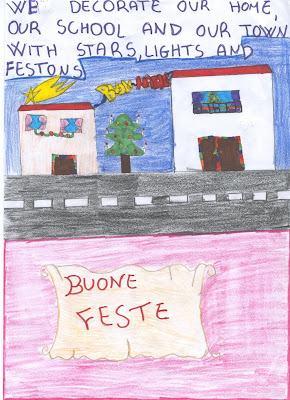
Decoriamo la nostra casa, la nostra scuola ed il nostro paese con stelle, luci e festoni.


La Notte di Natale andiamo in chiesa, mettiamo Gesù bambino nel presepe e festeggiamo con Panettone e spumante.

Riceviamo anche regali da Babbo Natale.


Il Giorno di Natale riceviamo regali e facciamo il pranzo di Natale con la nostra famiglia.


Mangiamo Panettone, "Cannaricoli", "Crespelle" e "Panzerotti" ( frittelle tipiche della nostra regione Basilicata).


La Notte di Capodanno festeggiamo con fuochi di artificio, balli e grandi cenoni di Capodanno.


Mangiamo zampone con lenticchie per augurare buona fortuna a tutti.


Il 6 Gennaio riceviamo doni dalla Bafana. E' una buona vecchia strega che scende giù dal camino.


Etichette:

sabato 22 dicembre 2007

In giro per i Frantoi/Around the oil mills

In giro per i frantoi

Lo scorso 11 c.m. gli alunni della classe 4^B della scuola primaria dell’Istituto Comprensivo “Don Bosco” hanno effettuato la visita al frantoio “Gioia-Morelli”.
E’ stata una visita interessante che ha coinvolto molto gli alunni, perché già a conoscenza dei metodi di lavorazione delle olive, avendo già visitato il frantoio “De Marco”, ma soprattutto perché hanno potuto confrontare i diversi metodi di lavorazione e vedere passo passo il cammino delle olive dalla tramoia alla molazza, al torchio, al separatore ed infine nei contenitori e da qui alla pesa.
Già, perché il frantoio “Gioia-Morelli”, a differenza del frantoio “De Marco”, che è completamente automatico, è un frantoio meccanico tradizionale, con le ruote che girano sulla molazza, con la pasta delle olive che viene messa nei diaframmi ( in sostituzione degli antichi fiscoli), con le presse idrauliche che schiacciano la pasta e con la presenza di alcuni lavoratori che dirigono e completano manualmente il lavoro delle macchine.
Gli alunni hanno immediatamente notato la differenza dei due frantoi, anche per la presenza all’interno del locale di un grande cumulo di sansa che nell’altro veniva depositato meccanicamente al di fuori del locale stesso e che rendeva scivoloso il pavimento costringendoli a camminare guardinghi.
Si sono soffermati incuriositi dal movimento delle ruote che giravano instancabili sulla molazza schiacciando le olive, e dal solerte lavoro degli operai che impilavano i diaframmi, carichi di pasta, sul carrello, che poi veniva spinto sotto la pressa idraulica che sostituisce l’antico torchio manovrato dalle braccia degli uomini.
Dopo aver osservato con crescente interesse i vari processi, hanno rivolto numerose domande al giovane proprietario che ha soddisfatto la loro curiosità con cortese sollecitudine.
Infine,con le scarpe sporche di olio e di sansa, con qualche conoscenza in più e con in testa una domanda che non avevano osato porre al giovane imprenditore ( Per quale motivo in questo frantoio non lavate le olive prima di metterle nella molazza?), sono rientrati a scuola giusto in tempo per evitare un furioso acquazzone che subito dopo si è abbattuto sul nostro paese.

Around the oil mills

On the last 11th c.m. the children of the class 4B of the primary school of the Istituto Comprensivo “Don Bosco” visited the “ Gioia – Morelli” oil mill.
It was an interesting visit that involved very much the children because they already had the knowledge of the different olive working processes , as they had already visited the “De Marco” oil mill, but especially because they could compare different way of oil production processes and see step by step the olives journey from the hopper, to the millstone, to the press, to the decanter and finally to the containers and from here to the weighing machine.
Yes, because the “Gioia-Morelli” oil mill, instead of the “De Marco” oil mill, that is completely automatic, is a traditional mechanical oil mill, with the wheels that turn on the millstone, with the olive paste that they put into the diaphragms ( in replacement of the ancient “fiscoli”), with the hydraulic presses that mash the paste and with the presence of some workers that guide and complete by hand the machines work.
The children noticed in a spot the difference between the two oil mills, also for the presence inside the room of a big husk heap that in the other one was put down mechanically outside the same room and that made the floor slippery allowing them to walk cautious.
They fixed their attention made curious about the wheels movement that turned tireless on the millstone crushing the olives, and about the diligent work of the workers that piled up the diaphragms, full of paste, on the trolley, that afterwards they pushed under the hydraulic press that replace the ancient press handled by the men arms.
After looking with growing interest the many processes , they asked many questions to the young owner who satisfied their curiosity with friendly promptness.
Finally, with their dirty of oil and husk shoes , with some more knowledge and with a question that they didn’t dare to ask the young entrepreneur in their head ( Why in this oil mill don’t you wash the olives before putting them into the millstone?) they came back to school just in time to avoid a furious storm that immediately afterwards hit our town.La molazza in cui vengono schiacciate le olive / The millstone where the olives are crushed
I diaframmi pieni di pasta di olive/The diaphragms full of olive paste
Una pila di diaframmi/ A pile of diaphragms
Le presse idrauliche /The hydraulic presses
Il separatore e l'olio/ The decanter and the oil
Un contenitore sulla pesa / A container on the weighing machine
Un cumulo di sansa nel frantoio / A husk heap inside the oil mill

Etichette:

venerdì 21 dicembre 2007

La Coppa del Mondo a Francavilla in Sinni:"Ero lì con i miei alunni!"/ The World Cup in Francavilla in Sinni:"I was there with my pupils!"


La coppa del mondo a Francavilla in Sinni :”Ero lì con i miei alunni!”

È stato un evento davvero eccezionale: la coppa del mondo è arrivata a Francavilla. E’ successo venerdì 14 c.m. Per interessamento del sig. Franco Cupparo,imprenditore locale e presidente della squadra calcistica del nostro paese, Francavilla ha avuto l’onore e il piacere di ospitare questo grande evento, un evento davvero grande ed irripetibile.
La coppa è stata esposta nel palazzetto dello sport “Luigi Console” con grande afflusso di pubblico.
I bambini della scuola primaria, limitatamente alle classi 3^, 4^ e 5^, hanno avuto il piacere di partecipare a questo evento dalle ore 10.30 alle ore 12.00.
Sono arrivati a bordo degli scuolabus pieni di ansia e di grande aspettativa,per cui altrettanto grande è stata la loro delusione nel vedere che la coppa non era come la immaginavano: grande, se non enorme. Ne avevano tanto parlato, discussioni infinite, tifo al cardiopalma, tante ore passate davanti allo schermo televisivo, giornali sportivi divorati insieme a mamma e papà, tanta rabbia per la testata di quel giocatore francese di cui ora non ricordano più il nome ma che allora avrebbero volentieri preso a pedate nel sedere, mulinelli fatte con le macchine per le vie del paese con in gola il grido di “ITALIA, ITALIA” e con i tricolori che svettavano dai finestrini e sventolando salutavano i loro fratelli più grandi e più piccoli esposti ai balconi e alle finestre di tutte le case, e tutto per quella cosa, bella sì ma così insignificante, esposta e protetta da una struttura in plexiglas e da due omoni in divisa di gala, sorridenti ma comunque preoccupanti, con degli occhi che sembravano dire: “Guarda ma non toccare, se no…”.
Tutto questo pensavano i ragazzi , con indosso una maglietta offerta dagli organizzatori, in fila nell’attesa di vedere più da vicino questa tanto decantata meraviglia. Man mano che si avvicinavano alla coppa però qualcosa cambiava dentro di loro, i visi si facevano più distesi, la curiosità si affacciava nei loro occhi, il desiderio di vederla si faceva più intenso ed infine la meraviglia esplodeva incontenibile in un continuo ripetere “Hai visto come è bella?”, “E’ piccola ma chi sa quanto pesa!”, “Ma sarà di oro massiccio?”, e così via, e per un attimo hanno risentito l’orgoglio di essere campioni del mondo insieme ai loro idoli, e come loro, tutti insieme, in piedi e con la mano sul cuore, hanno cantato l’inno nazionale e sembrava che per il palazzetto non echeggiasse l’antico, fiero inno cantato da tanti valorosi combattenti, ma una sana , romantica ed orgogliosa melodia pregna di vita e di gioia di vivere.

The World Cup in Francavilla in Sinni: “I was there with my pupils!”

It was a really exceptional event: the World Cup arrived in Francavilla. It happened on Friday 14th December, by the good offices of Franco Cupparo, entrepreneur and president of our town football team, Francavilla had the honour and the pleasure to give hospitality to this big event, a really big and unrepeatable event.
The Cup was shown in the in the Sport Palace “Luigi Console” with a big flow of people.
The children of the primary school, in limited way with the classes 3, 4, 5, had the pleasure to take part in this event from 10.30 to 12.00. they arrived by the school buses full of anxiety and big expectations, for which as much big was their disappointment in seeing the Cup was not such as they imagined it: big, if not enormous. They had talked a lot about it. Everlasting discussions, palpitations being fan, many hours spent watching TV, sport newspapers devoured with mum and dad, so much anger for the head hit of that French player whose name now they don’t remember but that at that time they’d have likely kicked, car whirlwinds for the town street with the cry “ ITALY! ITALY!” in their throat and with the Tricolore at the windows that flying greeted their bigger and smaller brothers shown at all the houses balconies and windows, and everything for that thing, of sure beautiful but insignificant, shown and protected by a plexigas structure and by two huge men in formal uniform, cheerful but worrying as well with their eyes that looked to say:” Look but don’t touch, otherwise…”
All that the children were thinking, wearing a T-shirt given them as a gift by the organizers, in queue looking forward to seeing with their eyes such as praised wonder.
But as they approached near the Cup something changed inside themselves, their faces became more relaxed, the curiosity appeared in their eyes, the desire to see it became more intense and finally the irrepressible astonishment blew up in a ongoing repeating : “Have you seen How beautiful it is?”,” It’s small but who knows how much it weighs?”, “But will it be made of solid gold ?”,and so on, and for a while they reheard the pride for being champions of the world with their idols, and just like them, all together, standing up with their hand on their heart, sang our national anthem and it looked as if, not the ancient proud anthem sang by many brave warriors, but a sound, romantic and proud melody full of life and of joy of living re-echoed through the sport palace.

Etichette:

lunedì 17 dicembre 2007

La Coppa del Mondo a Francavilla / The World Cup in Francavilla


Anche se non centra con il nostro progetto era, comunque, un evento degno di nota: venerdì 14 Dicembre i nostri alunni hanno avuto il privilegio di osservare da vicino e fotografare la Coppa del Mondo, vinta dalla nostra Nazionale nella scorsa edizione del campionato mondiale di calcio .

Even though it isn't related with our project, it was an event that we must notice as well: On friday 14th December our pupils had the privilege of looking with their eyes and of photographing the World Cup won by our National Team in the last world football champioship.
Il nostro partner inglese scherzosamente ha scritto:/ our English partner playfully wrote:
Yes you can rejoice now francavilla sul Sinni but maybe, just maybe, Signor Fabio Capello will help England to take this trophy from you in 2010. (or perhaps not knowing England !!)
Phil
Si tu puoi gioire adesso Francavilla sul Sinni ma forse, solo forse, il signor Fabio Capello aiuterà l'Inghilterra a prendersi questo trofeo da voi nel 2010.( o forse non si conosce l'Inghilterra!!)
Phil

Etichette:

lunedì 10 dicembre 2007

Visita al frantoio/ Visit at the oil mill

Francavilla, lì 8 dicembre 2007
Lo scorso venerdì gli alunni della classe 4^B dell’Istituto Comprensivo “Don Bosco” hanno compiuto una visita didattica al Frantoio “De Marco” in contrada Passeggeri. La visita era stata programmata da tempo ed ha dato inizio al progetto “Così facciamo l’olio” inserito nell’attività di partenariato che da alcuni anni la nostra scuola porta avanti in collaborazione con la classe 5^ della scuola elementare Churchfields di Newcastle- under- Lyme- England-UK. La visita ha avuto inizio alle ore 15.00 e termine alle ore 16.00. Gli alunni, accompagnati dagli insegnanti di classe Mango Gina e Martino Carmelo Mario, sono stati accolti dal sig. De Marco Felice, proprietario del frantoio insieme al fratello Antonio, che si è messo a loro disposizione illustrando le varie fasi di lavorazione e i diversi processi necessari all’estrazione dell’olio dalle olive. Ha spiegato inoltre il compito delle macchine presenti nello stabilimento ed ha risposto con competenza, unita a grande disponibilità, alle domande che i ragazzi gli hanno rivolto. L’esperienza diretta dei processi di lavorazione e i macchinari presenti nello stabilimento hanno interessato molto i ragazzi che lo hanno dimostrato sia con le domande , precise e pertinenti, che hanno rivolto al frantoiano, sia con le discussioni che si intavolavano tra i vari gruppetti, sia nella discussione collettiva seguita al rientro nella classe. La visita è stata documentata sia con numerose fotografie scattate sul posto, sia con la registrazione dell’intervista rivolta al signor De Marco. L’attività proseguirà con un’altra visita da fare al frantoio “Gioia”, prevista per il giorno 11 di questo mese, per mettere a confronto due diversi modi di molire le olive, con i lavori da svolgere a scuola per conoscere la storia dell’olio e le zone di coltivazione dell’olivo, con una indagine condotta tra gli anziani per conoscere il modo di produrre l’olio prima dell’avvento delle macchine moderne, ed infine con un’esperienza diretta, eseguita dai ragazzi a scuola, con il tentativo di estrarre l’olio con mezzi più a portata dei bambini.

Francavilla 8th December 2007
Last Friday the pupils of the class 4 B from the Istituto Comprensivo ”Don Bosco” have had a didactic visit at the “De Marco” oil mill in Passeggeri road. The visit had been planned some time ago and has started the project “ We make oil in this way!” included into the partnership activities that our school has been promoting with the class 5 of the Churchfields primary school in Newcastle-under- Lyme- England- UK. The visit started at 3.00 and ended at 4.00. The children accompanied by the class teachers Mango Gina and Martino Carmelo Mario, have been received by Mr. De Marco Felice, owner of the oil mill with his brother Antonio, that put himself at their disposal illustrating the different oil working phases and the different processes that are necessary for the oil extraction from the olives. He also explained the usage of the machines that are in the factory and answered the children's questions with authority linked to a big helpfulness . The direct experience with the production processes and with available machines in the factory interested a lot the children who shown that either through the questions, precise and pertinent, that they asked the oil mill owner or through the begun discussions among the many little groups, or through the sequential collective discussion when we came back to the classroom. The visit has been documented either by many photos taken on the place, or by the recorded interview addressed to Mr. De Marco. The activity will go on with another foreseen visit to do to “Gioia” oil mill on the 11th of the current month, to compare two different ways to process the olives, with the school works about the knowledge of the oil history and the olive cultivation areas, with a survey to do among the elderly to know the old oil production way before the advent of the modern machines, and, finally, with a direct experience, done by the children at school, with the attempt to extract oil with tools within children’s reach.

video
Il viaggio delle olive comincia da qui : osserviamo! / The olives trip begins from here: let's look!
video
Sacchi di olive accanto alla tramoia / Olive bags next to the hopper
video
Olive versate nella tramoia / Olives poured into the hopper
video
La tramoia ed il nastro trasportatore / The hopper and the conveyer belt
video
Il lavaggio e la macina /the cleaning machine and the oil press
video
Il primo separatore / The first decanter
video
Il secondo separatore e l'olio / the second decanter and the oil
video
La furiuscita della sansa all'esterno del frantoio / The husk overflow outside the oil mill

Etichette:

venerdì 7 dicembre 2007

Maschere, fuochi e falò: due culture a confronto/ Masks, fireworks and bonfires:two cultures in comparison


Così i nostri alunni hanno risposto alle richieste dei nostri partners/ In this way our children answered to our partners' requiests:
Carnevale, Capodanno ed alcune feste locali
Cari amici,
anche in Italia abbiamo delle feste simili alle vostre.
la prima è Carnevale.
Festeggiamo Carnevale in Febbraio o in Marzo, 40 giorni prima della Pasqua per tre giorni. Domenica, Lunedì e Martedì.
Durante questa festa ci mascheriamo da streghe, principesse, Spiderman, Zorro, Biancaneve ed altri. I bambini vanno di porta in porta e ricevono caramelle, cioccolate e soldi. L'ultima sera, a mezzanotte dopo una sfilata ed una festa, bruciamo un pupazzo fatto con vecchi vestiti, che rappresenta Carnevale, su un falò proprio come il vostro " Guy". Durante questi giorni , fra le altre cose, si mangiano un sacco di polpette.

A Capodanno festeggiamo con i fuochi di artificio l'arrivo del nuovo anno.
In estate festeggiamo con i fuochi di artificio anche alcune feste religiose locali come la " Madonna di Pompei", la "Madonna del Carmine", "S. Antonio" e altre.
Queste celebrazioni hanno luogo in chiesa, in processione per il paese e nella nostra "Villa Comunale". Lì, dopo un concerto, a tarda sera, possiamo ammirare i fuochi.
Ci piacciono molto i loro colori ed i loro disegni.
Qualche notizia in più: SulSinni.com
Classe 4^B
Carnival, New Year's Eve and some local festivities
Dear penpals,
In Italy we also have some festivities like yours.
The first is Carnival.
We celebrate Carnival in February or in March, 40 days before Easter for three days: Sunday, Monday and Tuesday.
During this festvity we put on masks like witches, princesses, Spiderman, Zorro, Snow-white and others.
Children go door to door and receive sweets, chocolates and money. The last night, at midnight, after a parade and a party, we burn a puppet made with old clothes, that represents Carnival, on a bonfire just like your "Guy". during these days, with the other things, we eat a lot of meatballs.
On New year's Eve we celebrate with fireworks the new year.
In summer we also celebrate with fireworks some local religious festivities such as "Madonna di Pompei", "Madonna del Carmine", "S. Antonio"and others.
These celebrations take place in the church, in procession around the town and in our Villa Comunale Park. There, after a concert at late night, we can see the fireworks. We like very much the fireworks, their colours and their patterns.
Some more news: SulSinni.com
From class 4 B

Etichette:

mercoledì 5 dicembre 2007

Cosa sappiamo della Bonfire Night/ What we know about the Bonfire Night


Dalle lettere dei nostri amici inglesi e dalle attività svolte in classe abbiamo conosciuto questa tipica festa inglese: ecco come immaginiamo i festeggiamenti della "Bonfire Night"o "Guy Fawkes Night"!(C'è molto di più sul nostro twinspace eTwinning)
Classe 5^A

From our English friends' letters and from our school activities we have known this tipycal English festivity: here's how we immagine the Bonfire Night or Guy Fawkes Night celebrations! ( There's much more on our eTwinning twinspace)
Class 5A

Etichette: